




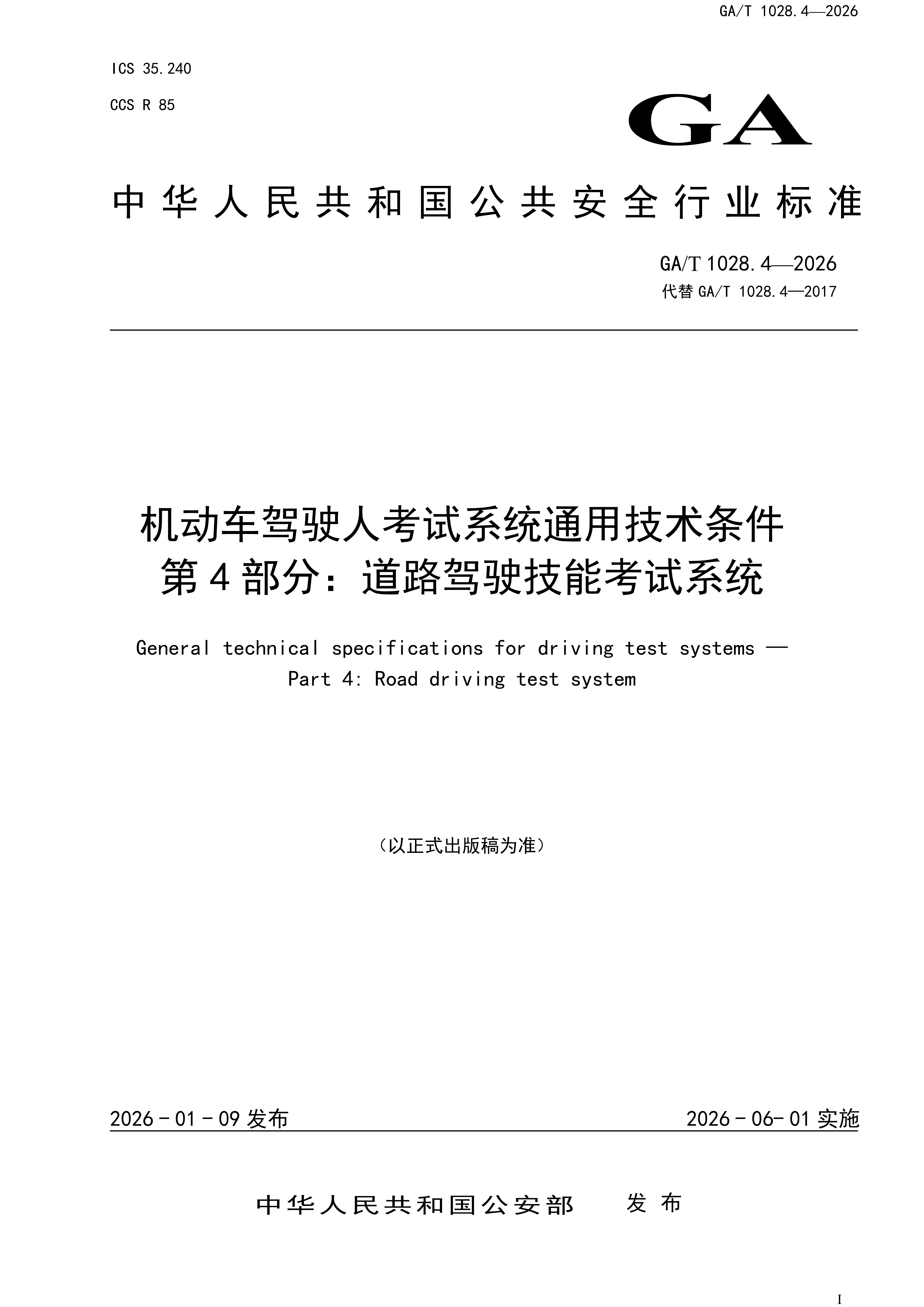
In 2026, GA/T 1028.4—2026 General Technical Specifications for Motor Vehicle Driver Test Systems – Part 4: Road Driving Skill Test Systems, jointly drafted by Duolun Technology, was officially released and will take effect on June 1, 2026. The new standard drives the intelligent transformation of Subject III (road driving skill) tests, enhancing the road safety competence of new drivers.
From "Procedural" to "Practical" Assessment
The new standard aligns closely with Ministry of Public Security Order No. 162 and relevant regulations, maintaining consistency with GA 1026, GA/T 1028.1, and other series standards. Its clear objective is to shift Subject III testing toward practical capability validation, establish a closed-loop "intelligent + manual" supervision system, and improve safe driving proficiency.
This revision spans two years. The drafting working group, led by the Road Traffic Safety Research Center of the Ministry of Public Security, included Duolun Technology as a core drafting unit. The company participated in the entire standard revision process, responsible for product functional performance testing, technical indicator validation, and providing extensive field test data and technical support for the feasibility and universality of computer-assisted evaluation items.
Standard Deep Dive
System Self-Check and Information Collection Upgrades
Stricter Self-Checks: The new standard specifies self-check objects (on-board signals, differential positioning, audio/video, etc.) and detailed procedures, with particular emphasis on audio/video signal self-checks to ensure continuous effective monitoring throughout the test, eliminating the risk of unmonitored examinations. All self-checks must be completed before launching the evaluation software.
Stronger Information Binding: The standard reinforces the unique binding of license plate number, switch IP, and VIN to on-board equipment, improving equipment management rigor and anti-cheating capabilities. Additionally, vehicle model and VIN must be collected and bound to the test vehicle license plate number, reducing the risk of unauthorized equipment changes.
Key Changes in Test Evaluation
(1) Addition of "Capable of Having" Evaluation Items
The original 58 "shall have" evaluation items have been expanded to 82, with 23 newly added computer-assisted evaluation items (including 1 item – "walk around the vehicle" – changed from "shall have" to "capable of having," and 22 entirely new items). These focus on test-oriented driving behaviors, such as:
Failing to select a reasonable driving speed based on traffic conditions (prolonged low-speed driving, commonly known as "driving like a turtle").
Failing to start within 10 seconds when conditions are met.
Failing to start within 10 seconds after the green light turns on when the road ahead is clear.
Failing to maintain a safe distance and safe speed while driving.
Failing to maintain a reasonable safety distance during lane changes, obstructing other vehicles.
Failing to stop and yield to pedestrians at crosswalks.
These evaluation items require additional hardware such as environmental perception cameras, millimeter-wave radar, and intelligent computing units, marking a critical step toward a more intelligent and practical test system.
(2) Refined "Simulated Night Light Usage" Test Standards
The standard specifies at least six test scenarios with random ordering, with "temporary roadside parking" designated as the final item to avoid operational conflicts. This standardizes the test process and prevents shortcuts, such as counting merely turning on the lights as a valid item.
(3) Upgraded "Shall Have" Evaluation Items
Corresponding to the newly added evaluation items in GA 1026—2022, the following have been added:
Continuous use of the starting gear for more than 50 meters (failure).
Failing to turn off the turn signal after completing the operation (10-point deduction).
Driving in the second-highest or highest gear for less than 5 seconds (10-point deduction).
Additionally, gear and speed matching requirements have been refined:
For small passenger cars: 2nd gear ≥5 km/h, 3rd gear ≥15 km/h, 4th gear ≥25 km/h, 5th gear ≥35 km/h.
For large vehicles: 3rd gear ≥10 km/h, 4th gear ≥20 km/h, 5th gear ≥30 km/h.
Test Instruction and Process Management Specifications
More Reasonable Instruction Triggers: Instructions must be triggered at positions where operational conditions are met, avoiding conflicting items. Evaluation items such as "fastening seatbelt" and "applying/releasing parking brake" are prohibited from being set as prerequisites for instruction triggers, preventing the system from inadvertently prompting examinees.
More Transparent Announcements: All point deductions must be announced in real time using standardized language. Voice announcement volume is standardized at 60–85 decibels, balancing clarity and comfort (the previous standard only specified a minimum of 60 dB without an upper limit).
More Comprehensive Process Monitoring: Control centers must monitor real-time audio/video feeds, test process information, and sensor signals (including at least door status, seatbelt, turn signals, service brake, parking brake, ignition switch, gear, clutch, engine speed, etc.) for all vehicles under examination. Camera resolution must be no less than 640×480.
Enhanced Test Data Management
Upgraded Audio/Video Playback: The standard adds a requirement for synchronized playback of evaluation sensor signal status during test reviews, enabling complete reconstruction of examinee operations and supervisor interventions, reducing evaluation disputes. Supports MP4/AVI format, with online playback and remote access for up to 3 years.
Trajectory Data Export: For tests using differential satellite positioning evaluation, trajectory data must be exported in accordance with GA/T 1028.1.
Data Security: Local query statistics and score printing functions have been removed. Test data is uniformly uploaded to the Motor Vehicle Driver Test Management System, in compliance with public security information data security requirements.
Overall Enhancement of Computer-Assisted Evaluation
In quantitative terms, the total number of deduction items remains 131, unchanged from the 2017 edition. However, computer-assisted evaluation items have increased from 58 to 82, including 67 "shall have" and 15 "capable of having" items, with 4 shared deduction items. This represents a net increase of 20 items, raising the automated evaluation rate from approximately 44% to 60%.
Cutting-Edge Technology Leading the New Standard
As one of the core drafting units for this standard revision, Duolun Technology was deeply involved in the full process, from technical content discussions to product functional performance testing and technical indicator validation, playing a particularly significant role in the direction of test evaluation.
Full-Subject Intelligent Evaluation with Leading Technical Strength
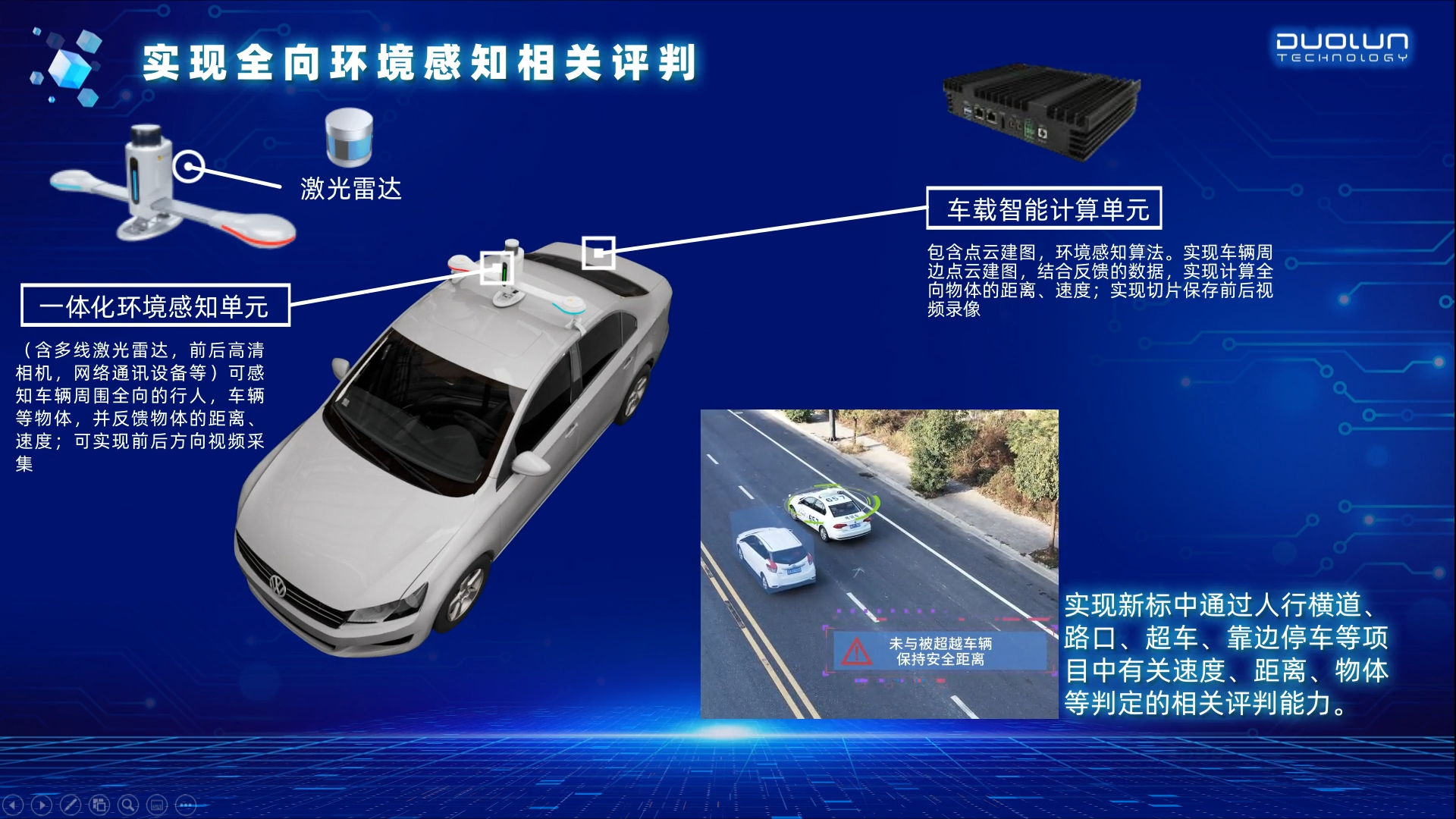
Duolun Technology's self-developed Subject III test system, powered by "vision perception + radar fusion + Beidou positioning," enables high-precision, multi-scenario automated evaluation.
Deep AI Application Addressing Test-Oriented Pain Points
Integrating AI vision analysis, environmental perception, and other technologies, the system achieves omnidirectional recognition of pedestrians, vehicles, and other objects around the test vehicle, providing real-time distance and speed feedback. It also enables forward and backward video capture. In particular, it delivers millisecond-level response and high-accuracy evaluation for persistent test-oriented issues such as "driving like a turtle," "changing lanes while stopping," and "failing to start at a green light."
The official release of this standard marks the entry of motor vehicle driver road skill tests into a new era driven by intelligence. This represents not only a comprehensive upgrade in technology but also a critical step in the deep transformation from "test-oriented driving" to "safe driving competence."
As a technological leader in the industry, Duolun Technology is fully prepared to empower test centers and driving schools nationwide with its mature next-generation intelligent driving test solutions, embracing the new era of intelligent, practical driving examinations.



 苏公网安备 32011502011140号