




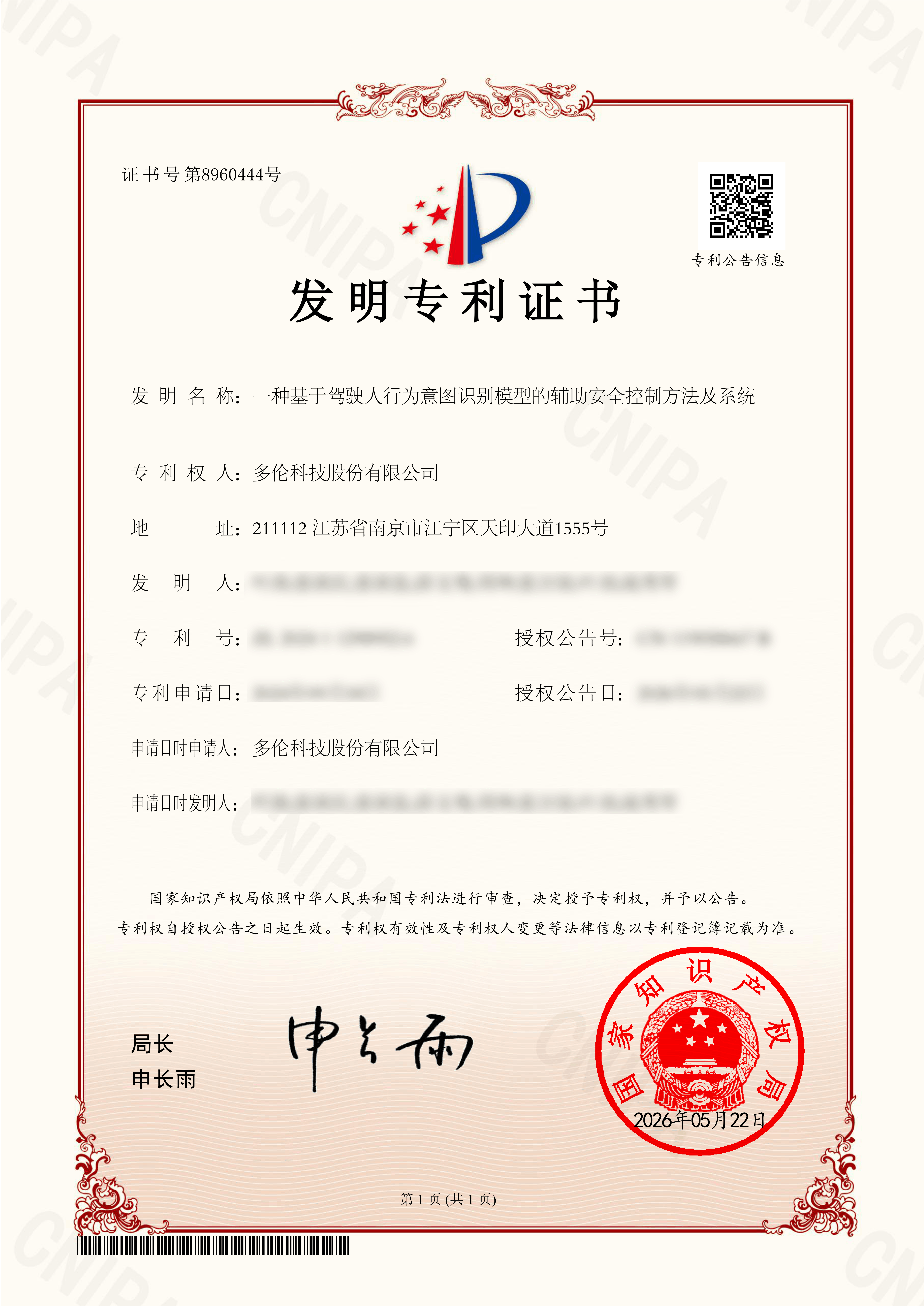
Recently, Duolun Technology was granted an invention patent by the China National Intellectual Property Administration for "Auxiliary Safety Control Method and System Based on Driver Behavior Intention Recognition Model." This marks a key breakthrough for the company in the intelligent driving test sector, providing core technological support for "unmanned" driving test safety.
The Pain Point: Long-Term Reliance on On-Board Safety Officers Carries Significant Limitations
In traditional driving tests, driving safety relies primarily on a safety officer seated in the passenger seat. This approach incurs high labor costs and is vulnerable to issues such as verbal prompting, subjective differences, and even cheating. Although local authorities have introduced monitoring systems, full-process supervision remains difficult given the massive volume of test data.
At the same time, commercially available ADAS (Advanced Driver Assistance Systems) are primarily designed for experienced drivers. When applied to driving test candidates – who are, by definition, inexperienced drivers – these systems frequently generate false alarms or miss critical situations. The driving test industry urgently needs a proactive safety solution that truly understands "candidate behavior."
The Solution: Systematically Recognizing Driving Intentions to Assist Safety Decisions
Comprehensive Perception: Through LiDAR, millimeter-wave radar, and cameras, the system captures real-time information on the position, speed, and direction of objects within a 360° range around the vehicle, identifying the closest targets to the vehicle in eight directions as "targets of interest."
Collision Risk Assessment: The system calculates the vehicle's trajectory in real time based on CAN bus data. It dynamically adjusts the Time-to-Collision (TTC) threshold for different target states – stationary, approaching at constant speed, accelerating, or decelerating. When a risk is predicted, a basic collision signal is output.
Driving Intention Recognition: Upon receiving the signal, the system calls upon in-cabin visual sensors to capture the candidate's behavioral features, including hand movements, head position, gaze direction, and pedal operations. These inputs are fed into a deep neural network model to assess in real time whether the candidate is actively attempting to avoid the collision (e.g., by decelerating or steering).
Final Braking Decision: If the system determines the candidate is not actively attempting to avoid the collision (e.g., still pressing the accelerator), it decisively outputs a braking command, activating the actuator to apply the brakes. If the candidate has taken effective action, the system does not intervene, respecting the driver's judgment.
Innovation: Omnidirectional Safety Protection + Intention-Driven Control
Omnidirectional Protection: The system does not merely focus on the forward direction. It also monitors collision risks in areas including front-left, front-right, left, right, and rear directions, effectively addressing unexpected occurrences during tests such as pedestrians, non-motorized vehicles, curbs, and vehicles approaching from behind.
Intention-Driven Control: For the first time, candidate behavioral intention is used as the core criterion for emergency braking. This resolves the traditional AEB problem in driving test scenarios – "failing to brake when needed, and braking when unnecessary" – ensuring both safety and preventing misjudgments that could affect test results.
Biomimetic Learning: The deep neural network model, built on extensive driving behavior data, continuously iterates and optimizes, becoming increasingly adept at understanding the operational characteristics of driving test candidates in China.



 苏公网安备 32011502011140号