




As the Spring Festival travel rush peaks in 2026, traffic pressure continues to mount in Longgang District, Shenzhen – a core transportation hub of the Guangdong-Hong Kong-Macao Greater Bay Area. On February 9, a new “police presence” made its debut on the streets at the Galaxy World Robot District in Bantian Subdistrict, Longgang. The intelligent traffic command robot, jointly developed by Longgang Traffic Police, Duolun Technology, and EngineAI, was officially put into operation. Adopting a “human + intelligent” integrated traffic control model, the robot helps safeguard the Spring Festival travel rush. This unique “mecha assistant police officer” has once again drawn global attention to Shenzhen's practice of leveraging technology for urban governance.
That this scene is unfolding in Shenzhen is no coincidence. As a benchmark city for innovation and vitality in China, Shenzhen’s AI core industry scale surpassed RMB 100 billion in 2025, with its robotics industry chain ranking among the most complete nationwide. Longgang District, as a major industrial hub, has been deeply cultivating AI and robotics on the foundation of its “IT + BT + low-carbon” industrial base. The Galaxy World Robot District, in particular, brings together a large number of tech innovation enterprises, creating a uniquely fertile environment for the deployment of intelligent traffic robots. This pilot of a robot traffic police officer represents a landmark initiative by Shenzhen to deeply integrate cutting-edge technology with urban governance, taking laboratory technologies out of the ivory tower and turning them into practical solutions to address the pain points of Spring Festival traffic control.
The successful deployment of this intelligent traffic command robot would not have been possible without the deep collaboration between Duolun Technology and EngineAI. Their partnership has been the core enabler of the technology’s real-world application. The robot body, developed by EngineAI, provides the foundation for stable operation. It is equipped with the industry’s first solid-state battery specifically designed for humanoid robots, delivering 4–5 hours of long endurance to meet the demands of extended duty during the Spring Festival travel rush. With a peak torque of 450 N·m and instantaneous power of 4000 W, the robot is capable of patrolling complex road surfaces and handling emergency responses. Its high-precision joint modules provide the hardware support for accurately replicating traffic command gestures. Meanwhile, Duolun Technology, with years of deep expertise in intelligent transportation, contributes profound scenario understanding and algorithmic capabilities. By integrating its “hardware + algorithms + scenarios” strengths with EngineAI’s hardware R&D and motion control expertise, the companies jointly customized and developed this “embodied intelligence” product tailored to the traffic characteristics of Longgang Bantian, an area known for dense pedestrian flow and significant peak-hour commuting demands.
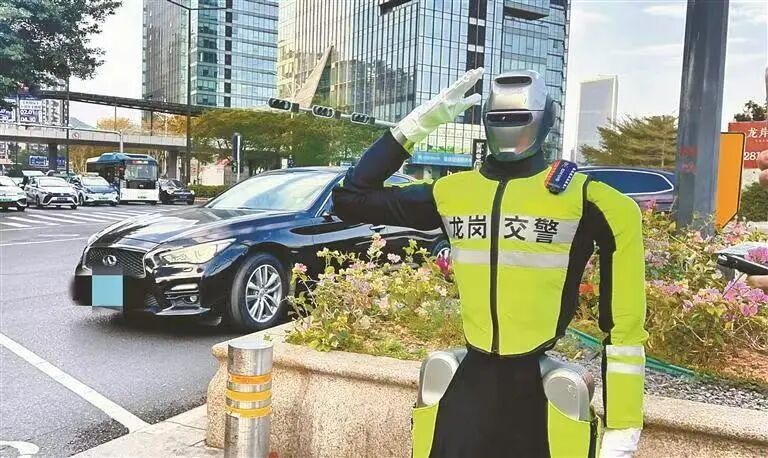
This robot, created through a powerful collaboration, precisely addresses the needs of Spring Festival traffic control. It unlocks three core functions: patrolling and public outreach, violation advisement, and signal coordination. Routine patrols at key intersections break through the spatial and temporal limitations of manual patrols. The voice broadcast module continuously delivers travel tips and traffic regulations, achieving an integrated “patrol + outreach” function. Using high-definition cameras and AI algorithms, the robot accurately identifies violations such as electric bicycle riders not wearing helmets or carrying passengers illegally, and provides real‑time voice advisories, forming a closed loop of “detection – advisement – warning.” This effectively compensates for manpower shortages during off-peak hours while promoting a culture of civilized travel through a gentle approach. After the Spring Festival travel season, the robot will also be connected to the local traffic signal control system. Leveraging EngineAI’s hardware modules and Duolun’s algorithmic support, it will achieve synchronized responses between gesture commands and traffic light changes, autonomously performing standard command actions and bridging response gaps during peak hours when manual command is needed.
The debut of the robot traffic police officer in Longgang has also drawn global media attention to China’s practical application of intelligent traffic robots. While the application of humanoid robots in public safety is a global trend, public traffic governance is one of the most demanding and high-stakes application scenarios. Shenzhen’s practice sends a clear signal to the world: China’s robotics industry is moving from “technology catching-up” to “application-defining.” Humanoid robots have transitioned from mere showpieces of technical prowess to truly entering high-responsibility, high-frequency urban governance scenarios. For now, the robot focuses on advisement and warning without enforcement powers, and all operational data will be strictly anonymized, exploring the boundaries and possibilities of robot participation in urban governance within a controlled scope.
Amid the Spring Festival travel flow, traditional policing and technological empowerment converge, with human officers and robot assistants working side by side to protect the public’s safe journey home. This pilot in Longgang represents a successful practice of the collaboration between Duolun Technology and EngineAI, and an important step forward in Shenzhen’s effort to build an integrated “human-vehicle-road-cloud” intelligent transportation ecosystem. Looking ahead, as technology continues to advance, this robot will further enhance its adaptability to diverse scenarios. The collaborative model of Duolun and EngineAI will also provide valuable references for the deeper integration of intelligent technology and traffic management, ensuring that the light of technology illuminates every intersection on our urban roads.



 苏公网安备 32011502011140号